
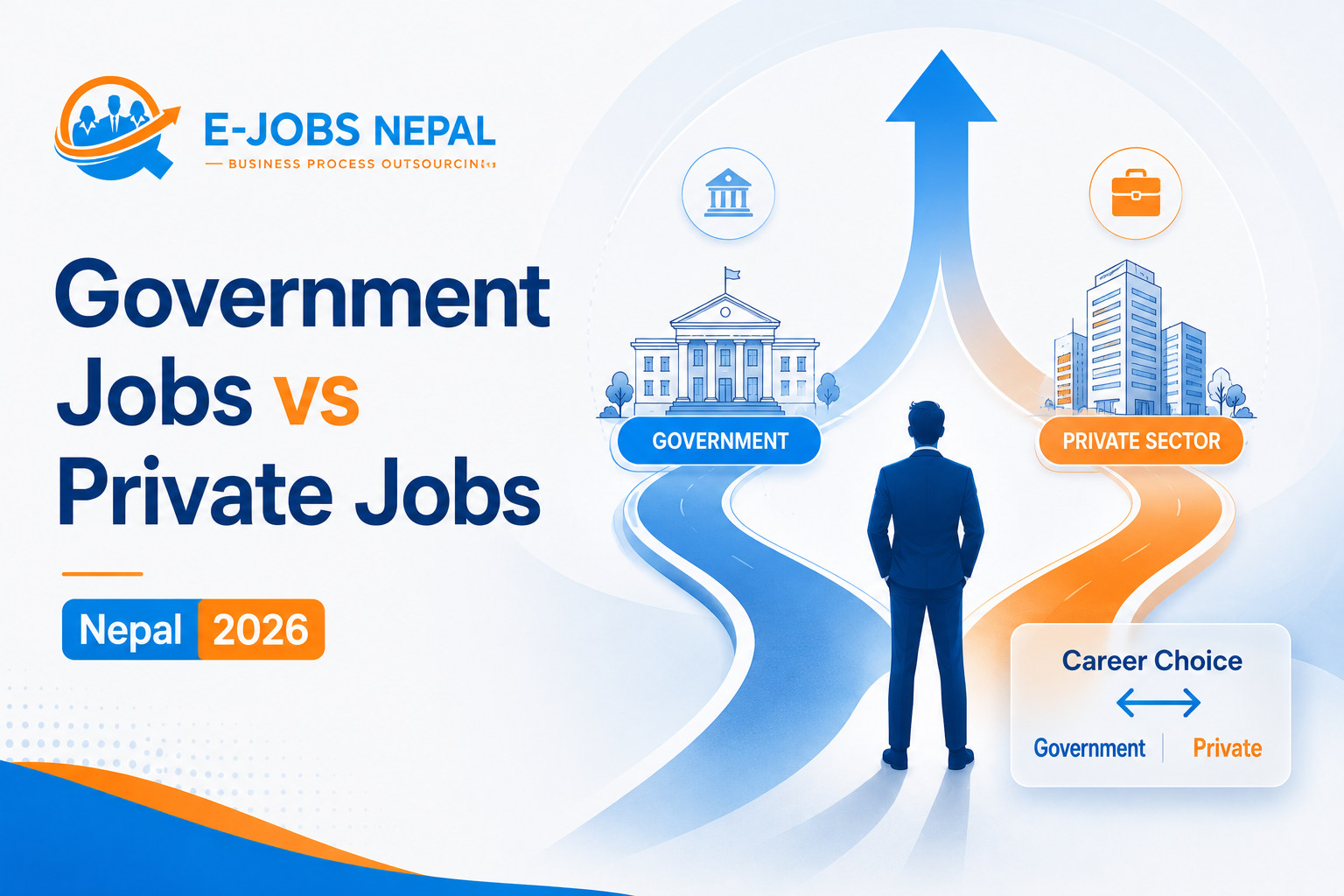
If you are a fresh graduate or young professional in Nepal deciding between Loksewa (the Public Service Commission exam) and the private sector, this is one of the most consequential choices you will make. The answer is not universal — the right path depends on your priorities, your tolerance for uncertainty, your financial goals, and your vision of what a good career looks like.
This guide gives you the honest comparison, based on 2026 salary data, career progression realities, and the lived experience of professionals in both sectors. We are not going to tell you ‘both are good in their own way’ — we are going to help you make an informed decision.
The Case for Government Jobs (Loksewa)
1. Unmatched Job Security
In Nepal, a gazetted government officer position is effectively permanent employment. Termination is rare and requires specific legal grounds. In a country where the private sector — including banks, NGOs, and businesses — has seen significant retrenchments since 2020, this security has real value. For professionals supporting families, carrying loans, or in regions where private employment opportunities are limited, this stability can be life-defining.
2. Pension and Long-Term Benefits
Government employees receive a defined benefit pension upon retirement — a monthly payment for life based on years of service and final salary. Private sector employees have provident fund (PF) contributions, but no guaranteed pension income. For a career spanning 25–30 years, the long-term value of a government pension is substantial and often underweighted in young people’s calculations.
3. Dearness Allowance and Non-Salary Benefits
Government salaries are supplemented by Dearness Allowance (adjusted periodically for inflation), Local Allowance, accommodation allowances for postings outside Kathmandu, vehicle allowances for certain grades, and fully subsidised staff medical facilities. The effective total compensation package for mid-career government officers is often higher than the basic salary alone suggests.
4. Respected Social Status
In Nepal’s social context, a gazetted officer or senior civil servant carries significant social capital — in family relationships, community standing, and marriage prospects. This is not a trivial consideration for many Nepali professionals and their families.
5. Work-Life Balance
Government offices in Nepal typically follow strict hours (10am–5pm), with no requirement for overtime or weekend working in most positions. While this has a downside (slower pace of career progression), it offers predictability that many private sector professionals — particularly those in banking, tech, or development work with international project demands — eventually find themselves envying.
The Case for Private Sector Jobs
1. Significantly Higher Earning Potential
A mid-level IT professional, bank manager, or INGO programme officer in Nepal can earn 2–4 times the salary of their equivalent in the civil service — particularly in Kathmandu. A gazetted officer at entry level earns approximately NPR 45,000–70,000 per month. An equivalent-experience software developer at a private IT firm might earn NPR 90,000–150,000, and one working for an international client remotely might earn NPR 150,000–250,000. The salary gap is real and it compounds over a career.
2. Faster Career Progression
In government service, promotions are primarily seniority-based. A capable, high-performing officer progresses at roughly the same pace as a mediocre one — the system does not reward performance at the pace the private sector does. In the private sector, strong performance can result in promotions, salary increases, and expanded responsibilities on a timescale of months rather than years.
3. Skills Development and Marketability
Private sector roles — particularly in IT, banking, INGO, and professional services — expose you to international best practices, technology platforms, and professional development frameworks that build market-relevant skills. This makes you more employable, both within Nepal and internationally. Civil service skills are less transferable to private sector or international roles.
4. Entrepreneurial Freedom
Private sector experience — client management, project delivery, business development — builds the foundations that most successful entrepreneurs draw on. Many of Nepal’s most successful business founders came through banking, IT, or consulting before launching their own ventures.
Side-by-Side Comparison
| Factor | Government / Loksewa | Private Sector |
| Entry salary | NPR 45,000–70,000 | NPR 25,000–150,000 (wide range) |
| Senior salary ceiling | NPR 150,000–200,000 | NPR 300,000–600,000+ (sector dependent) |
| Job security | Very high — effective permanence | Moderate — market and sector dependent |
| Pension | Defined benefit pension | Provident fund only — no guaranteed pension |
| Promotion speed | Seniority-based — slow | Performance-based — can be fast |
| Work-life balance | Predictable hours | Variable — demanding in banking, INGO, IT |
| Skills marketability | Lower outside government | High — especially IT, banking, INGO |
| Social status (Nepal context) | Very high | Sector dependent |
| International career options | Limited | Strong — especially IT, INGO, finance |
Which Should You Choose?
Choose government if: you prioritise security and pension over salary; you want predictable hours and sustainable work-life balance; you want to serve the public and build a civic career; or you are entering a specialised government role (central bank, judiciary, foreign service, Nepal Army) that genuinely offers a high ceiling.
Choose private if: maximising lifetime earning potential is important; you want to build internationally marketable skills; you are in IT, banking, INGO, or healthcare where private sector salaries genuinely exceed government rates; or you have an entrepreneurial mindset and want the experience that feeds it.
A third path — which many Nepal professionals are quietly choosing — is to begin in the private sector for 5–10 years, build skills, earnings, and savings, and then consider government or semi-government roles (Nepal Rastra Bank, constitutional bodies, development banks) at a mid-career level where the salary gap is smaller and the security more valued.
Find Jobs in Both Sectors on E-Jobs Nepal
E-Jobs Nepal lists verified vacancies across private sector, NGO/INGO, and government-adjacent roles. Set up job alerts for your preferred sector and role type — and never miss the right opportunity. ejobsnp.com