
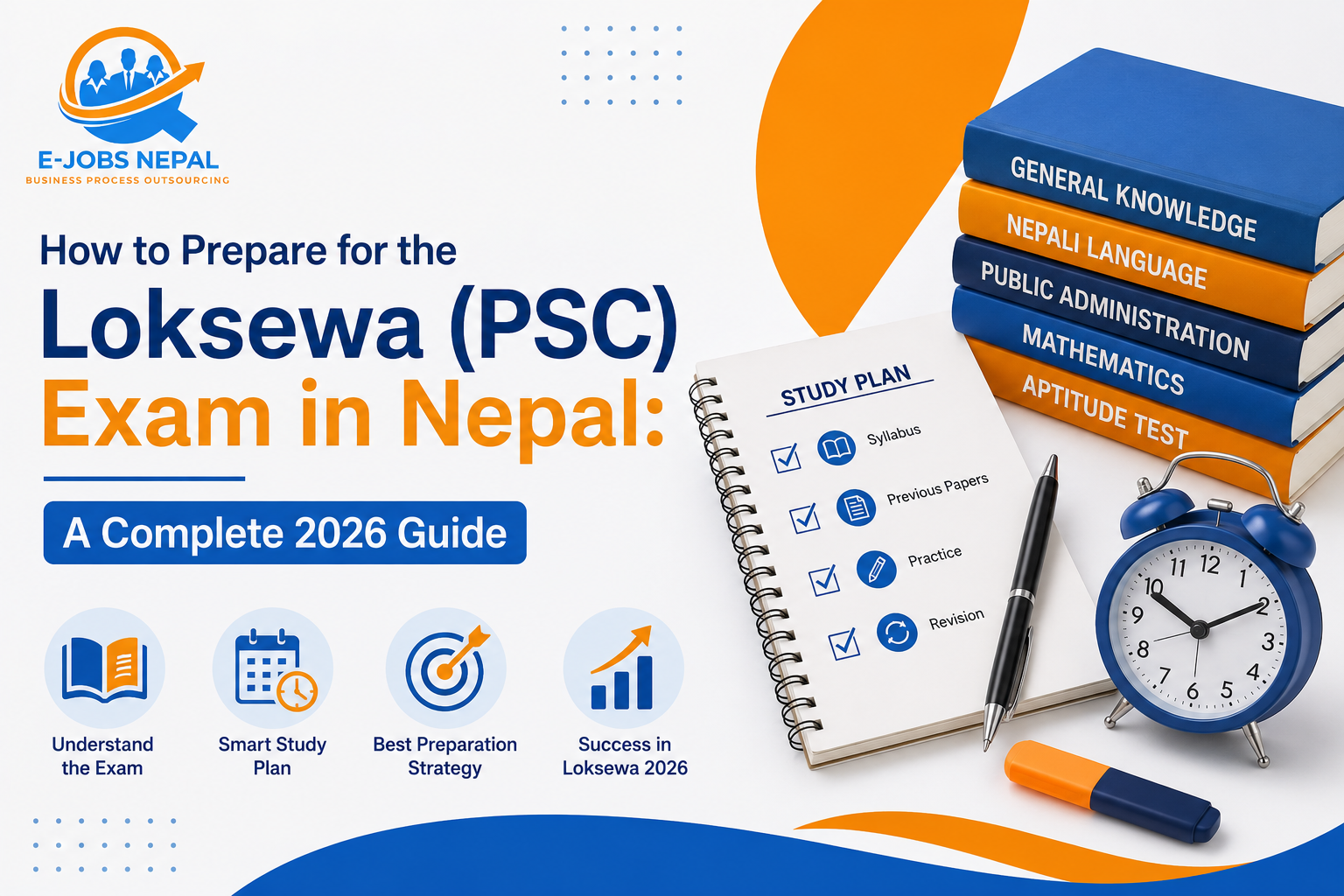
How to Prepare for the Loksewa (PSC) Exam in Nepal: A Complete 2026 Guide
The Loksewa exam administered by Nepal’s Public Service Commission (PSC) is the gateway to government employment in Nepal. It is also one of the most competitive and most prepared-for examinations in the country. Hundreds of thousands of applicants compete for a fraction of available positions in each cycle, and the standard of successful candidates has never been higher. If you are planning to sit the PSC exam in 2026 or 2027, this guide gives you the honest, structured preparation framework that top scorers use.
Understanding the Loksewa Examination Structure
The PSC conducts examinations for different levels and categories of government service. The main categories are:
| Service Level | Who It Is For | Examination Type |
| Rastriya Sewa (National Service) — Gazetted III | Entry-level officers (non-gazetted to gazetted) | Written + Practical/Interview |
| Rastriya Sewa — Non-Gazetted I | Technical and sub-officer level | Written + Practical |
| Rastriya Sewa — Non-Gazetted II/III | Assistant and lower technical level | Written |
| Pradesik (Provincial) Service | Provincial government officers | Written + Interview |
| Sthaniya (Local) Service | Local government officers | Written + Interview |
The specific syllabus, examination format, and competitive cutoff varies by service group, level, and technical subject. Always download the latest syllabus from the PSC’s official website (psc.gov.np) before beginning preparation syllabi are updated periodically and old preparation materials may not reflect current requirements.
Phase 1: Understand the Syllabus Thoroughly
The most common preparation mistake is beginning to study before fully understanding the syllabus structure. The PSC examination typically has two main components:
General Knowledge and Aptitude (GK/Aptitude)
This section is common across most levels and service groups and tests: general knowledge of Nepal (history, geography, polity, constitution, economy, culture); current affairs at national and international level; logical reasoning and aptitude; basic mathematics (arithmetic, algebra, data interpretation); general English or Nepali language; and knowledge of public administration, good governance, and public policy principles.
Technical/Subject-Specific Section
For technical services (engineering, healthcare, education, law, agriculture, etc.), there is an additional section testing deep knowledge of the relevant subject. This section distinguishes candidates who have merely memorised GK from those with genuine subject expertise.
Phase 2: Build Your Study Schedule
Successful Loksewa preparation requires a disciplined, structured study plan over a minimum of 6–12 months for competitive positions. A framework that works:
- Months 1–2: Foundation – complete one full read-through of the syllabus; identify your weakest areas; collect the core textbooks and PSC model sets
- Months 3–5: Core Study – systematic subject-by-subject study with notes; daily current affairs reading (The Kathmandu Post, Gorkhapatra for Nepali); weekly practice of past paper questions
- Months 6–8: Practice and Consolidation – full model set practice under timed exam conditions; identify pattern errors; intensive revision of weak areas
- Month before exam: Final Revision – no new topics; only revision of notes, model sets, and current affairs from the past 3 months
Phase 3: Current Affairs – The Non-Negotiable Daily Habit
Current affairs questions account for a significant portion of the GK section in every PSC examination, and they are also the differentiator between candidates with similar subject knowledge. Successful Loksewa candidates read the news daily without exception for months before the examination.
Specific areas to track for Nepal Loksewa current affairs: constitutional and political developments; national budget, economic indicators, and major government programmes; foreign relations and international agreements (particularly involving India, China, and bilateral donors); natural disasters and government response; major appointments in constitutional bodies and government ministries; and Nepal Rastra Bank monetary policy and financial sector developments.
Phase 4: Model Sets and Past Papers
Practicing under timed, exam-condition constraints is irreplaceable. Do not study indefinitely without sitting full model sets. For each model set:
- Sit it under strict exam conditions timed, no notes, no phone
- Mark it honestly against the answer key
- For every wrong answer, understand why not just what the right answer is
- Record your error patterns are you consistently missing history, or current affairs, or quantitative reasoning? This tells you where to focus revision
- Track your score over time a rising trend indicates effective preparation
Published PSC model sets and past papers are available from Ratna Pustak Bhandar, Ekta Books, and online PSC preparation platforms. The PSC also publishes past examination questions on its official website.
Phase 5: Interview Preparation (For Gazetted Levels)
For gazetted officer-level examinations, passing the written component leads to an interview. The interview is conducted by a PSC panel and tests: communication and presentation skills; knowledge of your subject area and the specific service you have applied for; understanding of current policy issues and government priorities; analytical thinking and problem-solving; and personal integrity and motivation for public service.
Preparation for the interview requires: thorough knowledge of the current government’s policies and programmes relevant to your service; understanding of Nepal’s constitution and the role of the civil service within it; practice answering questions aloud not just in your head; and ideally, mock interview practice with a study group or coaching centre.
Resources and Community
Nepal’s Loksewa preparation community is active and well-organised. Key resources include: psc.gov.np (official PSC site syllabus, notices, model questions); Loksewa online forums and Facebook groups; coaching institutes in Kathmandu (New Buspark, Jamal areas) that offer structured Loksewa courses; and E-Jobs Nepal’s career resources section for government job vacancy alerts.
Track the latest Loksewa vacancy notices and government job alerts at ejobsnp.com