
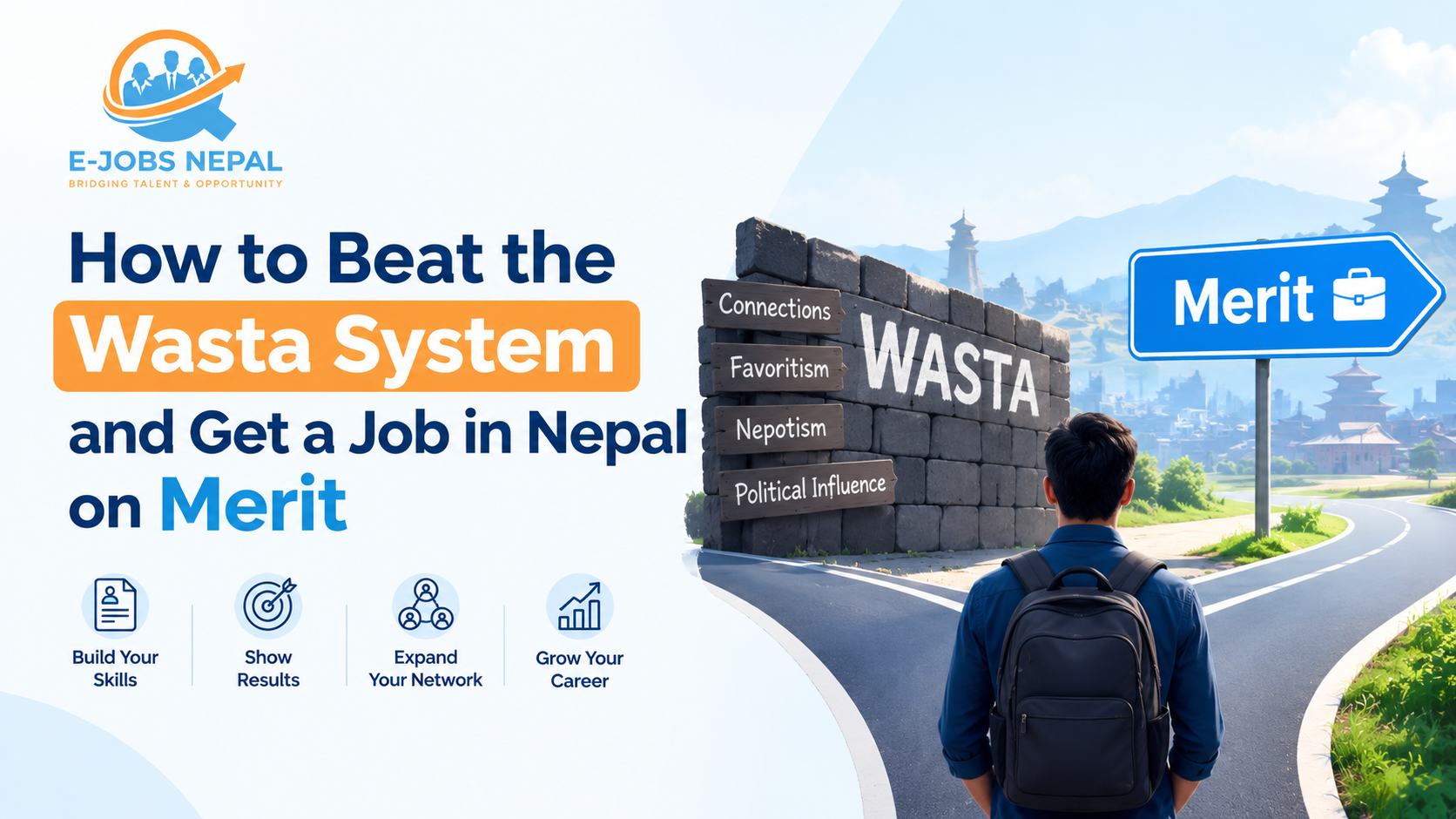
If you have ever applied for a job in Nepal and watched a less-qualified candidate get hired because they knew someone, you have experienced wasta — the system of connections, favours, and social capital that runs quietly alongside the formal recruitment process in Nepal’s public and private sectors alike.
Wasta in Nepal is real. It exists in Nepali organisations at every level. But it is not the only factor that determines who gets hired — and in a growing number of sectors, merit has become a genuinely competitive advantage. This guide is honest about the challenge and practical about what you can do to win jobs on the strength of what you know and what you can do.
Understanding the Problem Honestly
Wasta — loosely translated as connections, nepotism, or the use of social influence in professional decisions — is not unique to Nepal. It exists in most societies to varying degrees. In Nepal, it intersects with caste, ethnicity, regional identity, and family networks in ways that make it structurally embedded in certain sectors, particularly government and large Nepali corporates.
However, it is important not to overstate its uniformity. In Nepal’s IT sector, INGO sector, and international-facing financial services firms, merit-based hiring has become the norm — partly because the organisations themselves are accountable to international donors, investors, or clients who would not accept nepotistic hiring, and partly because in knowledge-intensive fields, the cost of hiring an unqualified person is immediately visible in the work.
Sectors Where Merit Wins
| Sector | Wasta Influence Level (Honest Assessment) | Merit Advantage |
| Government/Loksewa | High — seniority and connection remain significant | Exam performance is publicly scored and visible |
| INGOs/UN agencies | Low — rigorous, documented hiring processes | Strong skills + experience wins consistently |
| International IT/remote work | Very low — international clients assess output | Skill is the only metric that matters |
| Nepal banking (commercial) | Medium — networks help, but qualifications essential | CA, ACCA, relevant degrees create real advantage |
| Large Nepali corporates | Medium to high — depends heavily on the organisation | Portfolio and measurable achievements help |
| Startups and tech companies | Low to medium — output-focused culture | Technical skills, portfolio, GitHub profile win |
Strategies That Shift the Balance Toward Merit
1. Make Your Work Visible Before You Apply
In most wasta-influenced environments, the person who gets the job is the known quantity. If you are unknown, you are at a disadvantage from the start. The way to become known before you apply is to make your work publicly visible. For IT professionals: a maintained GitHub portfolio, contributions to open-source projects, or a technical blog that demonstrates your knowledge. For finance professionals: published analysis, commentary on Nepal’s economic developments, or community involvement in professional associations. For any sector: LinkedIn content that demonstrates your thinking and expertise.
When a hiring manager sees your name in a job application and they already know your work from LinkedIn or a community event, you have partially neutralised the connection advantage of a candidate with wasta but no visible track record.
2. Apply to Organisations With Transparent Hiring Processes
Not all Nepali organisations hire the same way. INGOs, UN system agencies, and international companies with Nepali operations are required to follow documented, competitive hiring processes. Many now use blind initial screening, structured interview scoring, and external reference checks. Targeting these organisations does not mean giving up on other sectors — it means building your career in environments where merit is genuinely the dominant factor.
3. Build Credentials That Are Hard to Fake
Professional certifications that require public examination — CA, ACCA, CFA, Google, AWS, PMP, IELTS scores — provide documented, verifiable evidence of competence that is much harder to override with connection than a subjective interview impression. These credentials signal quality to international and INGO employers who do not have the social context to evaluate Nepali educational institutions, and they are increasingly valued by progressive domestic employers as well.
4. Network — But Do It Merit-Focused
This is not about giving up on networking — it is about understanding what kind of networking helps. Wasta-style networking (asking Uncle Ramesh to call his friend at the company) is less scalable and less portable than merit-based professional networking. Attending industry events, joining professional associations, contributing to sector communities, and building a LinkedIn network of people who know your work creates a network that travels with you across employers and sectors.
5. Choose Sectors and Employers That Reward What You Have
If you have strong technical skills and a verifiable portfolio but limited social connections, targeting sectors and employers where technical skills demonstrably win is a more efficient strategy than fighting for roles in sectors where connection remains dominant. The freelance and remote work market — entirely merit-based — is one of the highest-value options for skilled Nepali professionals who want to bypass wasta entirely.
The Long Game: Building Wasta Based on Reputation, Not Relationship
The most powerful professional networks are built on reputation — people who refer you because they know your work is excellent, not because of family or caste ties. This takes years to build, but it is durable, portable, and grows over time rather than depleting with each favour asked. The Nepali professionals who are most successful long-term build this kind of reputation-based wasta through consistent, excellent, publicly visible work.
Search merit-based job listings on E-Jobs Nepal: ejobsnp.com